> MICHELANGELO
Italian Renaissance sculptor, painter, and architect whose works include David, the Pietà, and the Sistine Chapel ceiling.
Overview
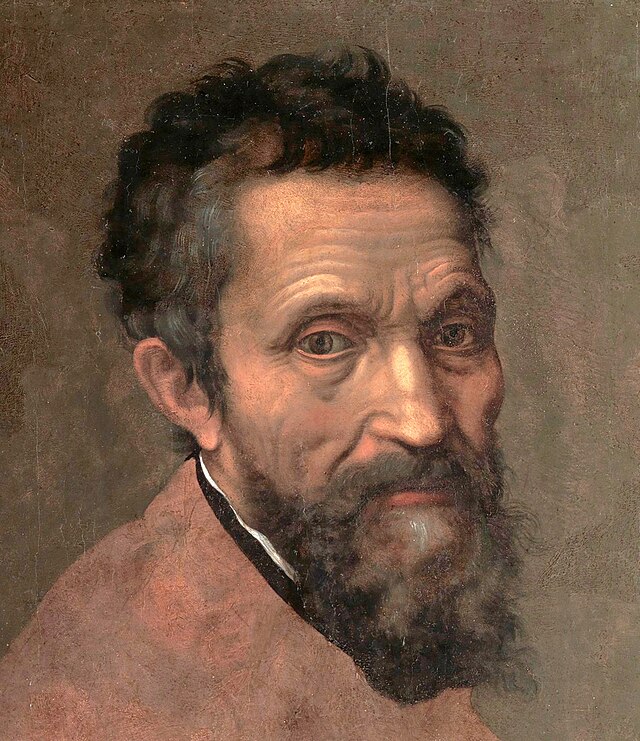
Michelangelo Buonarroti was one of the towering figures of the Italian Renaissance and one of the most influential artists in Western history. A sculptor, painter, architect, and poet, he produced works that have defined the European visual imagination for five centuries. His contemporaries already called him Il Divino — "the Divine One" — for the sheer emotional and technical force of his art.
Early Life and Training
Michelangelo was born in 1475 in Caprese, Tuscany, and raised in Florence, then the cultural capital of Europe. He was apprenticed at thirteen to the painter Domenico Ghirlandaio, but was quickly drawn to sculpture. The Medici family recognized his talent and welcomed him into their household, where he studied classical statuary and absorbed the humanist ideas then transforming Florentine thought. By his early twenties he had already produced the Pietà for St. Peter's Basilica in Rome, a marble group of such tenderness and anatomical precision that it made him famous across Italy.
Major Works
Returning to Florence, Michelangelo carved the seventeen-foot David (1501–1504) from a single block of marble that other sculptors had abandoned. It became a civic symbol of the young republic. In 1508, Pope Julius II commissioned him to paint the ceiling of the Sistine Chapel in Rome. Working for four years, often alone and lying on his back on scaffolding, Michelangelo covered more than five thousand square feet with scenes from Genesis, including The Creation of Adam. Later, he returned to paint the chapel's altar wall with The Last Judgment. In old age he turned to architecture, designing the dome of St. Peter's Basilica — the template for domes from London to Washington, D.C.
Legacy
Michelangelo worked for nine popes and redefined what an artist could be: not a craftsman, but a visionary whose reputation could rival that of princes. His letters and poetry, preserved in thousands of pages, show a sharp, self-critical mind grappling with faith, desire, and mortality. He died in Rome in 1564, a few weeks short of eighty-nine. His influence on sculpture, painting, and architecture stretches from his direct successors through Bernini, Rodin, and countless modern artists.
Did You Know?
- Michelangelo considered himself primarily a sculptor, not a painter.
- The block of marble used for David had been rejected by two previous sculptors.
- He designed the dome of St. Peter's Basilica in his late eighties.
- His poetry fills several surviving volumes but was rarely published in his lifetime.