> SPUTNIK 1
First artificial satellite launched by the Soviet Union, marking the beginning of the Space Age.
Overview
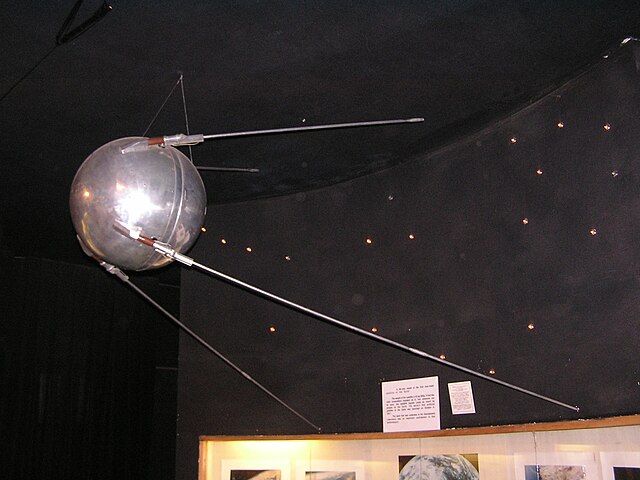
Sputnik 1 was the world’s first artificial satellite, launched by the Soviet Union on October 4, 1957. Its successful orbit around Earth marked the beginning of the Space Age and triggered the Space Race between the United States and the Soviet Union.
Background
During the Cold War, both superpowers were competing for technological and military superiority. The Soviet Union’s launch of Sputnik 1 demonstrated its advanced rocket capabilities and shocked the world, particularly the United States.
The Launch
Sputnik 1 was a small, spherical satellite equipped with radio transmitters. It orbited Earth every 96 minutes, sending simple “beep” signals that could be detected worldwide. Though technologically simple, its success proved that space travel was achievable.
Impact
The launch led to major changes in science and education, especially in the United States, which quickly expanded its space program. It also contributed to the creation of NASA in 1958.
Legacy
Sputnik 1 remains a symbol of innovation and the beginning of human activity in space. It paved the way for satellites, space exploration, and modern communication systems.
Did You Know?
- Sputnik means “satellite” in Russian.
- It orbited Earth for about three months.
- It transmitted signals until its batteries died.
- It sparked the creation of NASA.