> FRENCH REVOLUTION
A decade of upheaval in France that toppled the monarchy, reshaped politics, and influenced modern revolutions worldwide.
Overview
The French Revolution was a major political and social upheaval in France between 1789 and 1799. It began amid a deep financial crisis, widespread hunger, and growing anger at a social system that favored the clergy and nobility. Over the course of a decade, the Revolution destroyed the old monarchy, challenged inherited privilege, and introduced powerful new ideas about citizenship, rights, and national sovereignty.
Often seen as a turning point in modern history, the French Revolution transformed France from an absolute monarchy into a republic, though not without violence and instability. Its events also helped spread revolutionary ideals across Europe and beyond.
Background
Before 1789, France was organized under the Ancien Régime, a system that divided society into three estates: the clergy, the nobility, and everyone else. The Third Estate, which included peasants, urban workers, and the middle class, paid most taxes while holding little political power. Meanwhile, costly wars, including support for the American Revolution, had left the French crown deeply in debt.
Poor harvests in the late 1780s drove up bread prices and increased public unrest. Enlightenment thinkers such as Jean-Jacques Rousseau, Montesquieu, and Voltaire had also criticized absolute rule and promoted ideas of liberty, reason, and popular sovereignty. These economic pressures and intellectual currents created the conditions for revolution.
Key Moments
The Revolution is often dated from May 1789, when King Louis XVI called the Estates-General to address the financial crisis. After disputes over voting, representatives of the Third Estate declared themselves the National Assembly. In June 1789, they took the Tennis Court Oath, promising not to disband until France had a constitution.
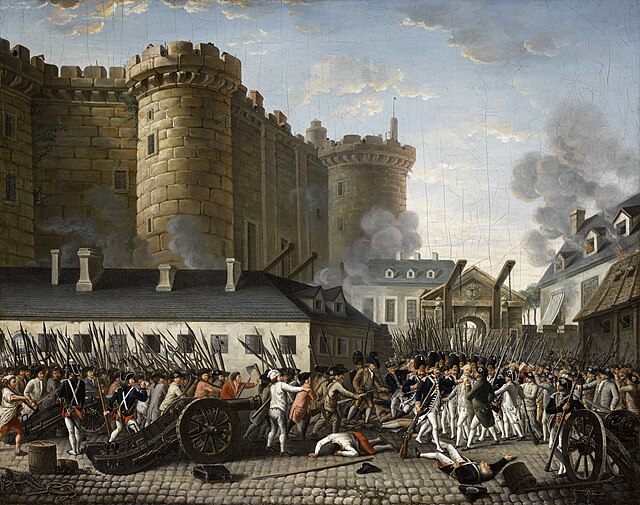
On July 14, 1789, Parisians stormed the Bastille, a fortress-prison that symbolized royal authority. This act became one of the Revolution’s defining moments. Soon after, the National Assembly adopted the Declaration of the Rights of Man and of the Citizen, which proclaimed liberty, equality before the law, and national sovereignty.
The Revolution grew more radical in the following years. In 1792, the monarchy was abolished and France became a republic. King Louis XVI was executed in January 1793, followed later that year by Queen Marie Antoinette. During the Reign of Terror, led in part by Maximilien Robespierre and the Committee of Public Safety, thousands were executed as revolutionary leaders sought to crush enemies at home and abroad.
Impact and Legacy
By 1799, the Revolution had entered another phase of instability. That year, Napoleon Bonaparte seized power in a coup, effectively ending the Revolution’s most turbulent period. Even so, its effects were lasting. Feudal privileges were abolished, the authority of the Catholic Church was reduced, and the principle of equal citizenship gained stronger legal footing.
The French Revolution also had a broad international legacy. It inspired reformers, nationalists, and revolutionaries in Europe, Latin America, and elsewhere. At the same time, it showed how movements for liberty could descend into political violence. Historians continue to debate its meaning, but its central importance is clear: the French Revolution helped define modern politics by linking government to the will of the people rather than the divine right of kings.
Did You Know?
- Bastille Day, celebrated on July 14, is France’s national holiday and commemorates the storming of the Bastille in 1789.
- The guillotine became a symbol of the Revolution, though it continued to be used in France long after the 1790s.
- The revolutionary government introduced a new calendar in 1793, with renamed months and a ten-day week.
- The slogan often associated with the Revolution is “Liberty, Equality, Fraternity,” though it became official in France later.
- Women played important roles in the Revolution, including the October 1789 march to Versailles that pressured the royal family to return to Paris.