> NIGHTHAWKS
Edward Hopper's Nighthawks is a landmark 1942 painting that captures urban isolation in a brightly lit late-night diner.
Overview
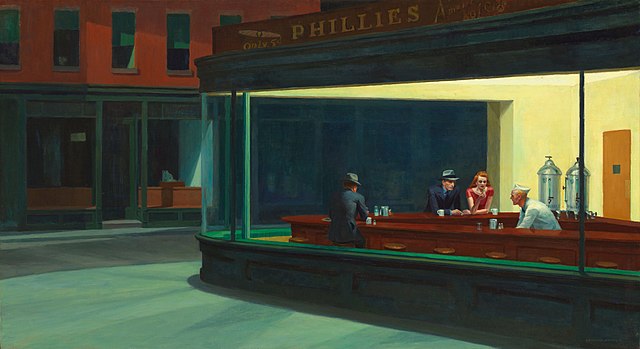
Nighthawks is a 1942 oil painting by American artist Edward Hopper and one of the most recognizable works in modern American art. It depicts three customers and a server inside a brightly illuminated corner diner at night, viewed from the outside through a wide expanse of glass. The street beyond is empty, and no doorway into the diner is visible from the viewer’s angle, heightening the sense of distance and separation.
Created during World War II, the painting has often been associated with themes of loneliness, anxiety, and urban alienation. Yet Hopper himself avoided overly specific interpretation, preferring to let the image speak through mood, setting, and composition. Today, Nighthawks is held by the Art Institute of Chicago, where it remains a centerpiece of its American art collection.
Creation
Hopper painted Nighthawks in his New York studio, drawing inspiration from the streets of Manhattan. He later said the idea came from a restaurant on Greenwich Avenue, though the final image was not a literal portrait of one real location. Instead, it was a carefully constructed scene combining observation, memory, and artistic invention.
His wife, the artist Josephine Hopper, played an important role in documenting the work. Her notes identify the figures and record details about the painting process. She reportedly served as the model for the woman in the diner, while Hopper may have modeled the male customer in profile after himself.
The Art Institute of Chicago purchased Nighthawks shortly after it was completed in 1942, helping establish the painting’s early public reputation. Its immediate acquisition by a major museum reflected Hopper’s standing as a leading American realist painter.
Style and Technique
Nighthawks is celebrated for its strong geometry, controlled lighting, and cinematic atmosphere. Hopper used sharp diagonals and curved glass to draw the eye into the diner, while the darkened street and simplified storefronts create a stark contrast with the warm interior. The result is both realistic and strangely theatrical.
Although Hopper is often labeled a realist, the painting is not simply documentary. He reduced detail, eliminated clutter, and arranged forms to intensify emotional effect. The lack of visible entrance, the stillness of the figures, and the near-total absence of street life all contribute to its psychological tension.
Light is central to the painting’s power. The diner glows under fluorescent illumination, which was still relatively modern in the early 1940s. This artificial light isolates the figures instead of making them feel connected, turning an ordinary late-night eatery into an emblem of modern city life.
Legacy
The legacy of Nighthawks extends far beyond the museum world. It has become a visual shorthand for solitude, nighttime cities, and American modernity. The painting has been widely reproduced in books, posters, and classrooms, and it frequently appears in discussions of 20th-century American art.
Its influence can also be seen in film, photography, and popular culture. Directors and designers have echoed its framing and mood, especially in works that emphasize urban quiet, introspection, or suspense. The painting’s pared-down setting allows viewers to project many narratives onto it, which helps explain its lasting appeal.
Art historians continue to debate whether Nighthawks should be read mainly as a wartime image, a study of modern isolation, or a broader meditation on human distance. Its openness to interpretation is part of what keeps it relevant.
Did You Know?
- Nighthawks was painted by Edward Hopper in 1942 and acquired that same year by the Art Institute of Chicago.
- The diner in the painting was inspired by New York, but it was not an exact copy of a single real restaurant.
- Josephine Hopper, Edward Hopper’s wife, helped document the painting and likely modeled for the seated woman.
- No door is visible to the viewer, a compositional choice that adds to the painting’s sense of separation and mystery.