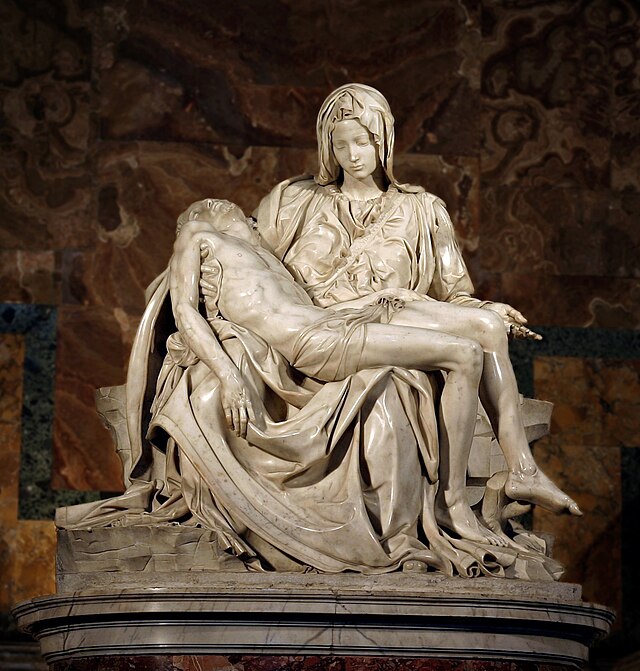
> PIETA (MICHELANGELO)
Michelangelo’s Pieta is a High Renaissance marble sculpture in St. Peter’s Basilica, celebrated for its beauty, realism, and technical mastery.
Overview
The Pieta by Michelangelo is one of the most famous sculptures of the High Renaissance. Carved in marble between 1498 and 1499, it shows the Virgin Mary holding the body of the dead Christ after the Crucifixion. Today, the work is housed in St. Peter’s Basilica in Vatican City, where it remains a major landmark of Renaissance art.
Michelangelo created the sculpture while still in his early twenties, yet it immediately established his reputation in Rome. The Pieta combines religious emotion with idealized beauty, presenting a scene of grief with remarkable calm and balance. Unlike many earlier depictions of the same subject, Michelangelo’s version emphasizes serenity rather than dramatic anguish, making it one of the clearest examples of Renaissance ideals applied to Christian art.
Creation
The sculpture was commissioned by Jean de Bilhères, a French cardinal and ambassador to the papal court, for his funeral monument. Michelangelo selected a single block of Carrara marble, a material he prized for its fine quality and luminous surface. His ability to transform this stone into soft flesh, flowing drapery, and delicate facial expression became a defining feature of his early career.
The Pieta was completed in less than two years. Its polished finish is especially notable, as Michelangelo refined the marble to an unusually smooth surface that enhances the sculpture’s lifelike presence. The work was originally intended for a chapel in Old St. Peter’s Basilica before later being moved to its current location.
Style and Technique
Michelangelo’s Pieta is admired for its technical precision and harmonious composition. Mary is shown as youthful and idealized, a choice that has drawn attention for centuries. Rather than depicting her as an older mother, Michelangelo gave her a calm, almost timeless appearance, likely to symbolize purity and spiritual incorruptibility.
The composition is pyramidal, with Mary’s broad drapery supporting Christ’s body in a stable, balanced arrangement. This structure helps unify the figures and gives the sculpture a sense of quiet dignity. Christ’s body is rendered with careful anatomical study, yet the overall effect remains graceful rather than starkly realistic.
Another important detail is the contrast between textures. The heavy folds of Mary’s robes create visual depth and conceal the structural support needed for Christ’s reclining body. At the same time, Christ’s torso, arms, and legs are carved with smooth naturalism. This blend of artistic beauty, engineering skill, and theological meaning helped make the Pieta a masterpiece of Renaissance sculpture.
Legacy
The Pieta holds a special place in Michelangelo’s career because it is the only work he ever signed. His name appears across the sash running over Mary’s chest. According to early accounts, he added the signature after hearing the sculpture attributed to another artist.
Over the centuries, the Pieta has become a model of devotional art and an icon of Western sculpture. It influenced later artists through its ideal proportions, emotional restraint, and refined treatment of marble. In modern times, it has also become known for its survival and protection. After being damaged in an attack in 1972, the sculpture was carefully restored and is now displayed behind protective glass.
Did You Know?
- Michelangelo completed the Pieta when he was only about 24 years old.
- It is the only sculpture Michelangelo ever signed.
- The work was carved from a single block of Carrara marble.
- Mary appears younger than expected, reflecting Renaissance ideals of purity and timeless beauty.
- The sculpture has been kept behind protective glass since it was damaged in 1972.