> THE BIRTH OF VENUS
Sandro Botticelli’s The Birth of Venus is a landmark Renaissance painting celebrated for its mythological subject and graceful style.
Overview
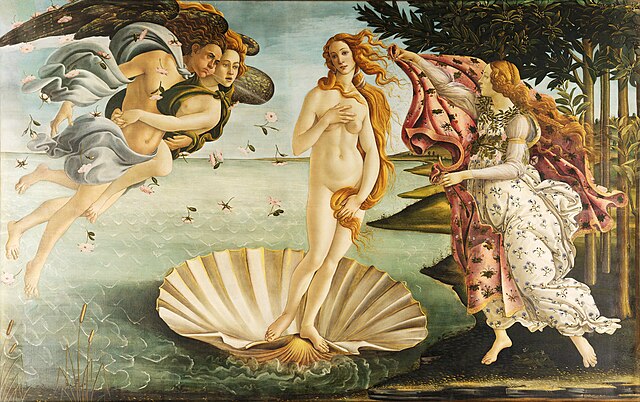
The Birth of Venus is one of the most famous paintings of the Italian Renaissance. Created by Sandro Botticelli around 1485, it shows the goddess Venus arriving at the shore after her birth from the sea. Today, the painting is housed in the Uffizi Gallery in Florence, where it remains a major attraction and a key work in art history.
Painted in tempera on canvas, The Birth of Venus was unusual for its time because large mythological scenes were less common than Christian subjects. The work reflects the growing Renaissance interest in classical antiquity, beauty, and humanist ideas. Venus stands at the center on a shell, while Zephyrus, the god of the west wind, blows her toward land and a female figure waits to cover her with a floral cloak.
Creation
Botticelli likely painted The Birth of Venus for a member of the powerful Medici circle, though the exact commission remains uncertain. Florence in the late 15th century was a center of artistic innovation, and patrons increasingly supported works inspired by ancient Greece and Rome. This cultural climate helped make a mythological image like The Birth of Venus possible.
The subject was probably influenced by classical texts and Neo-Platonic philosophy, which linked physical beauty with spiritual truth. Rather than presenting Venus as a purely pagan figure, the painting may have been understood as an ideal of divine beauty and love. This blending of classical mythology and Renaissance philosophy was common in elite Florentine culture.
Style and Technique
Botticelli’s style in The Birth of Venus is defined by elegance, linear rhythm, and decorative beauty. Venus is not rendered with strict anatomical realism; instead, her elongated neck, sloping shoulders, and flowing hair create a graceful, almost dreamlike effect. The composition emphasizes contour and movement over naturalistic space.
The figures appear weightless, and the sea and shoreline are simplified rather than fully realistic. This gives the painting a poetic quality that sets it apart from the more scientific naturalism of some other Renaissance artists. Botticelli used tempera to create delicate color transitions and crisp outlines, helping the image retain its clarity and decorative appeal.
The painting also contains symbolic details. Roses fall through the air, likely representing love, while the shell suggests both birth and beauty. Venus’s pose echoes ancient sculptural models, especially the modest Venus type, in which the goddess attempts to cover herself.
Legacy
The Birth of Venus became one of Botticelli’s defining masterpieces and later a symbol of Renaissance art itself. Although Botticelli’s reputation declined for a time after his death, the painting was rediscovered and widely admired in the 19th century. Since then, it has become an iconic image reproduced in books, posters, fashion, and popular culture.
Art historians value the work not only for its beauty but also for what it reveals about Florence in the 1480s: its classical interests, intellectual ambitions, and changing ideas about art. The painting remains important because it shows how Renaissance artists could reinterpret ancient mythology in a distinctly new way.
Did You Know?
- The Birth of Venus is painted on canvas, which was less common in Florence than wooden panels at the time.
- The scene does not literally show Venus being born, but rather her arrival on land after emerging from the sea.
- The woman on the right is often identified as one of the Horae, goddesses associated with the seasons.
- Botticelli’s Venus was likely inspired in part by ancient Roman sculpture and Renaissance ideals of perfect beauty.