> THE GARDEN OF EARTHLY DELIGHTS
Hieronymus Bosch’s triptych is a landmark of Northern Renaissance art, famed for its vivid symbolism and enduring mystery.
Overview
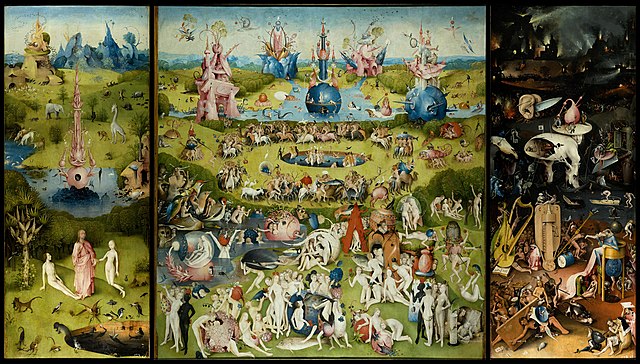
The Garden of Earthly Delights is a triptych painting by the Dutch artist Hieronymus Bosch, created around c. 1490–1510 during the Northern Renaissance. Today it is housed in the Museo del Prado in Madrid and is widely regarded as Bosch’s most famous work. The painting is made up of three interior panels, with outer shutters that can be closed to reveal a monochrome image of the world during Creation.
When opened, the left panel shows the Garden of Eden, with God presenting Eve to Adam. The central panel presents a vast and puzzling landscape filled with nude figures, oversized fruits, strange animals, and fantastical structures. The right panel depicts a dark, nightmarish vision often interpreted as Hell. Together, the panels form one of the most discussed and enigmatic artworks in European history.
Creation and Historical Context
Bosch worked in the Duchy of Brabant, in the Low Countries, at a time of strong religious belief, urban growth, and rising interest in moral imagery. His paintings often explored sin, temptation, judgment, and human folly. Although the exact commission for The Garden of Earthly Delights is not fully documented, it was likely intended for an elite patron rather than a church altar.
The triptych format was commonly used for religious works, but Bosch used it in an unusually imaginative way. Instead of presenting a straightforward biblical narrative, he created a complex visual meditation on innocence, desire, pleasure, and punishment. Scholars still debate whether the central panel should be read as a warning against lust, a vision of humanity before the Flood, or a more ambiguous reflection on earthly life.
Style and Symbolism
Bosch’s style combines precise observation with extraordinary invention. He painted birds, plants, and human bodies with convincing detail, yet placed them in impossible situations that feel dreamlike and unsettling. This blend of realism and fantasy helped make the work one of the most distinctive masterpieces of Renaissance art.
The symbolism of the painting remains difficult to decode with certainty. Fruits may suggest sensual pleasure or transience; exotic animals may imply temptation or moral disorder. Musical instruments in the Hell panel are often linked to punishment, and bizarre hybrid creatures heighten the sense of chaos. Rather than offering a single simple message, the painting invites layered interpretations rooted in late medieval Christianity and Bosch’s highly original imagination.
Legacy and Influence
The Garden of Earthly Delights has had a lasting impact on art history. It influenced later artists interested in fantasy, moral allegory, and the strange, and in the modern era it has often been connected to Surrealism because of its vivid, irrational imagery. Even so, Bosch’s work belongs firmly to the religious and moral culture of his own time.
The painting continues to attract scholars, conservators, and visitors because it resists easy explanation. Its combination of technical skill, symbolic density, and visual invention has made it a central subject in the study of Hieronymus Bosch, Northern Renaissance painting, and the history of symbolic art.
Did You Know?
- The painting is a triptych, meaning it consists of three main panels with hinged outer wings.
- When closed, the outer panels show a grayscale image often interpreted as the world on the third day of Creation.
- The work is in the Museo del Prado in Madrid, where it remains one of the museum’s best-known masterpieces.
- Bosch never titled the painting himself; The Garden of Earthly Delights is a later descriptive name.
- The right panel’s bizarre punishments have led many viewers to nickname it Bosch’s “musical hell.”