> THE GREAT WAVE OFF KANAGAWA
Hokusai’s The Great Wave off Kanagawa became an icon of Japanese art through its striking design, printmaking skill, and global influence.
Overview
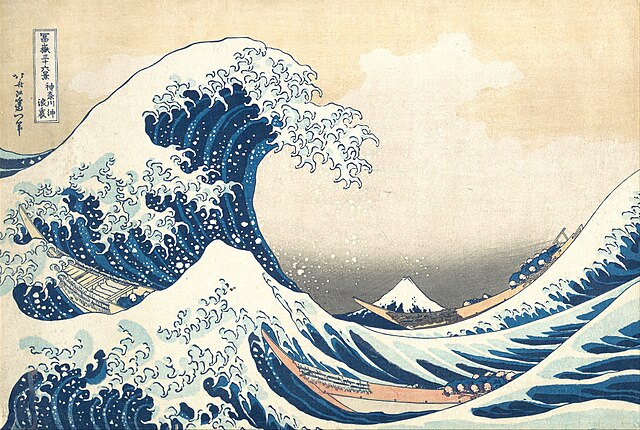
The Great Wave off Kanagawa is a world-famous Japanese woodblock print designed by Katsushika Hokusai around 1831, during the late Edo period. It is the best-known image from his series Thirty-Six Views of Mount Fuji. The print shows a towering wave curling over three boats, while the small, distant form of Mount Fuji appears beneath the stormy sky. Though often called a painting, it is actually a color woodblock print, produced through a collaborative process involving the artist, carvers, printers, and publisher.
The work captures both movement and tension. The wave appears almost alive, its claw-like foam about to crash onto the fishermen below. At the same time, Mount Fuji stands calm and still in the background, creating a striking contrast between nature’s force and enduring stability. This balance helped make the image one of the most recognized artworks in history.
Creation
Hokusai created the print at a time when landscape art was becoming more popular in Japan. Travel had increased, and famous places such as Mount Fuji attracted growing public interest. Publishers responded by producing affordable prints for a broad urban audience. The Great Wave off Kanagawa was issued by the publisher Nishimuraya Yohachi as part of a commercial print series rather than as a one-of-a-kind artwork.
The print was made using the ukiyo-e technique, in which separate carved woodblocks were used for each color. One important feature of this print is its use of imported Prussian blue, a pigment that had recently become available in Japan. This deep, durable blue gave the sea its dramatic intensity and helped the image stand out from earlier prints.
Style and Technique
Hokusai’s composition is carefully structured. The giant wave frames Mount Fuji, drawing the viewer’s eye between foreground drama and distant calm. The boats, likely fast transport vessels known as oshiokuri-bune, emphasize the scale of the sea and the danger faced by the crew. Their low position in the composition makes the wave seem even larger.
The print also reflects a blend of Japanese and Western visual ideas. Traditional ukiyo-e methods are clear in the bold outlines and flat color areas, while the sense of depth shows some awareness of European perspective. This combination gave Hokusai’s landscapes a fresh and modern look for his time.
Legacy
Over the nineteenth century, The Great Wave off Kanagawa traveled beyond Japan and became highly influential abroad. After Japan opened more fully to international trade, Japanese prints reached Europe and inspired artists associated with Impressionism and Post-Impressionism. Painters and designers admired Hokusai’s cropping, asymmetry, and strong graphic forms.
Today, the print is a symbol of Japanese art and a major example of global visual culture. It appears in museums, textbooks, posters, and digital media worldwide. Scholars continue to study it for its technical mastery, historical context, and changing meanings. For some viewers, it represents the power of nature; for others, it reflects human vulnerability or the enduring presence of Mount Fuji in Japanese identity.
Did You Know?
- The Great Wave off Kanagawa is the first and most famous print in Hokusai’s series Thirty-Six Views of Mount Fuji.
- Multiple impressions of the print exist because woodblock prints were produced in editions, not as single originals.
- The vivid blue color comes largely from Prussian blue, a synthetic pigment imported into Japan.
- Although many people call it “Hokusai’s Wave,” Mount Fuji is also a central subject of the composition.