> THE LAST SUPPER
Leonardo da Vinci’s The Last Supper transformed religious art through dramatic composition, psychological depth, and experimental technique.
Overview
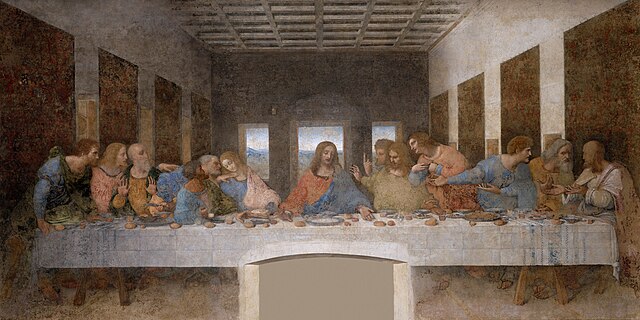
The Last Supper is one of the most famous artworks of the Italian Renaissance. Painted by Leonardo da Vinci between about 1495 and 1498, it covers the wall of the refectory at Santa Maria delle Grazie in Milan, Italy. The mural depicts the moment in the Gospel story when Jesus tells his disciples that one of them will betray him. Rather than showing a static religious scene, Leonardo created a dramatic and human interpretation filled with movement, emotion, and tension.
Commissioned by Ludovico Sforza, Duke of Milan, the painting was designed for a Dominican convent dining hall. Its setting was important: monks eating in the refectory would have viewed Christ’s final meal as a spiritual model linked to the Eucharist. Today, The Last Supper remains a landmark of Western art history and a major tourist destination.
Creation
Leonardo worked on the mural during his years at the Sforza court. Unlike traditional fresco painting, which required pigment to be applied quickly onto wet plaster, Leonardo used an experimental method on dry plaster with tempera and oil-like materials. This allowed him to refine details and achieve subtler effects of light, expression, and texture.
However, the technique proved unstable. The painting began deteriorating not long after completion. Humidity, wall damage, neglect, and later interventions caused severe losses over the centuries. Despite this, the composition itself survived well enough to preserve Leonardo’s revolutionary design.
The artwork measures roughly 4.6 by 8.8 meters (15 by 29 feet), making it monumental in scale. Its large size and placement on an end wall create the illusion that the dining hall extends into the painted room.
Style and Technique
Leonardo organized the twelve apostles into four groups of three, each reacting differently to Christ’s announcement. This grouping gives the scene rhythm and clarity while emphasizing individual personalities. Jesus sits calmly at the center, forming a stable triangular shape that contrasts with the agitation around him.
The composition is a classic example of linear perspective. All major perspective lines converge toward Christ’s head, making him both the visual and spiritual focal point. The windows behind him also frame the central figure, reinforcing his importance.
Another major innovation is the psychological realism. Earlier depictions of the Last Supper often presented the disciples in a more formal and symbolic way. Leonardo instead explored shock, doubt, anger, and confusion through gesture and facial expression. Judas Iscariot is not isolated on the opposite side of the table, as in many earlier works; he sits among the others, though set apart by shadow and posture.
Legacy
The influence of The Last Supper has been enormous. It shaped later religious painting, especially in its use of narrative drama and emotional interaction. Artists across Europe studied its composition and adapted its groupings, gestures, and perspective techniques.
The mural has also become central to discussions of art conservation. Major restoration campaigns, especially the long restoration completed in 1999, aimed to stabilize the surface and recover surviving original passages while removing damaging overpainting. Scholars still debate aspects of the restoration, but it helped preserve the work for future generations.
Beyond art history, The Last Supper remains deeply embedded in popular culture. It is frequently reproduced, referenced, and reinterpreted, confirming its enduring status as one of Leonardo da Vinci’s most celebrated masterpieces.
Did You Know?
- The Last Supper is painted on a wall, but it is not a true fresco, which is one reason it deteriorated so quickly.
- Leonardo reportedly worked slowly and sometimes spent long periods studying figures before applying paint.
- During World War II, the refectory was heavily damaged by bombing, but the wall containing the mural survived.
- The painting captures the specific instant after Jesus says, “One of you will betray me.”
- Santa Maria delle Grazie, the church and convent housing the mural, is a UNESCO World Heritage Site.