> VENUS DE MILO
An ancient Greek sculpture famed for its beauty, mystery, and enduring influence on Western art.
Overview
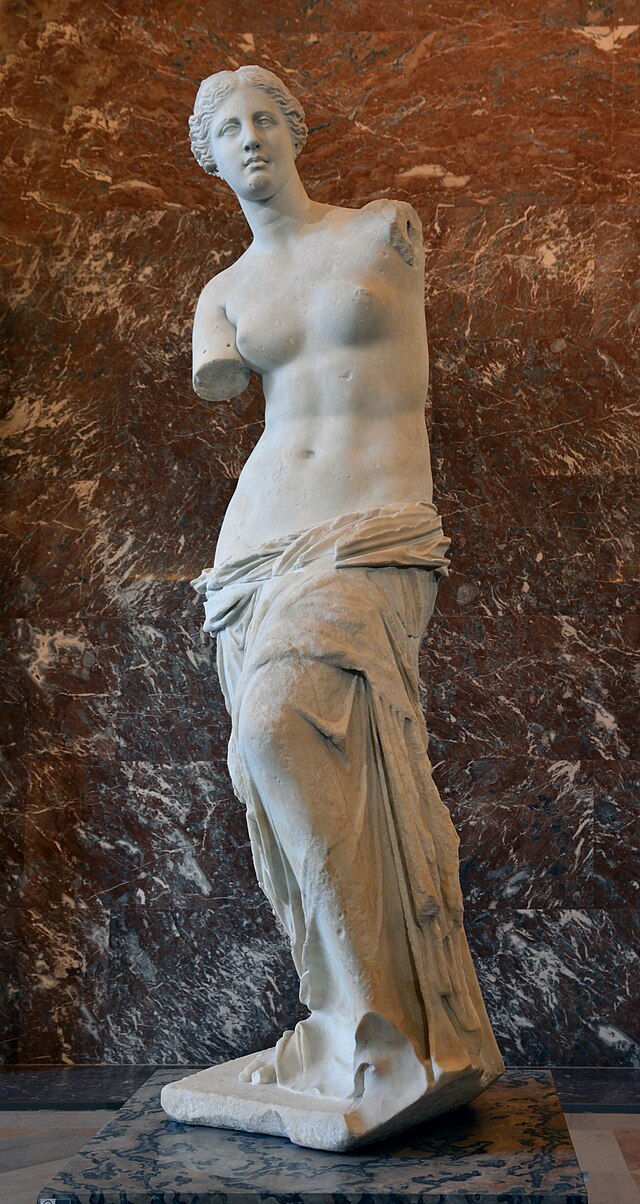
The Venus de Milo is one of the most famous surviving sculptures from ancient Greece. Believed to have been created around 150 BCE, the marble statue is usually identified as Aphrodite, the Greek goddess of love and beauty, though some scholars have proposed other identities. Today it is housed in the Louvre Museum in Paris, where it remains a major symbol of classical art.
The statue stands just over 2 meters tall and is admired for its calm expression, balanced pose, and flowing drapery. Its missing arms have added to its mystique, inspiring centuries of debate about its original appearance. Because of its beauty and strong association with classical ideals, the Venus de Milo became one of the best-known artworks in the world.
Discovery and Attribution
The sculpture was discovered in 1820 on the island of Milos, then part of the Ottoman Empire and now in Greece. According to historical accounts, it was found by a local farmer among the ruins of an ancient site. French naval officers and diplomats quickly recognized its importance and arranged for it to be sent to France.
Soon after its arrival, the statue was presented to King Louis XVIII, who donated it to the Louvre. At a time when France sought to rebuild its artistic prestige after the loss of other famous works, the acquisition of the Venus de Milo was culturally significant.
An inscription found with the statue linked it to Alexandros of Antioch, a sculptor active during the Hellenistic period. Earlier scholars had preferred to see the work as a masterpiece from the Classical age, but the inscription supported a later date. Today, most experts accept that it was created in the Hellenistic era, while also drawing heavily on earlier Classical traditions.
Style and Technique
The Venus de Milo is carved from marble and combines naturalism with idealized beauty. Its torso is modeled with soft transitions and careful attention to anatomy, while the lower body is wrapped in a richly carved garment that slips dramatically around the hips. This contrast between nude flesh and folded drapery is a hallmark of Greek sculptural design.
The statue’s pose shows a subtle twist through the body, creating a graceful sense of movement without sacrificing stability. This blend of serenity and motion reflects Hellenistic craftsmanship, yet its restraint also recalls the harmony of fifth- and fourth-century BCE Greek art.
The missing arms remain the sculpture’s greatest mystery. Various reconstructions suggest that Aphrodite may have held an apple, a shield, or part of her drapery. None can be confirmed with certainty, but these theories help scholars interpret how the figure may once have interacted with space and viewers.
Legacy
The Venus de Milo has had a lasting impact on art history, museum culture, and popular imagination. In the 19th century, it became a model of feminine beauty and a celebrated example of ancient Greek genius. Artists, writers, and critics frequently referred to it as an ideal work of sculpture.
Its fame also reflects the rise of major European museums and the use of classical art in shaping national prestige. In modern times, the sculpture has appeared in textbooks, advertisements, films, and satire, proving its continuing relevance far beyond archaeology.
For historians and museum visitors alike, the Venus de Milo endures as both an extraordinary artifact of Hellenistic Greece and a powerful reminder of how artworks gain new meanings over time.
Did You Know?
- The statue was found on the Aegean island of Milos, which is why it is called the Venus de Milo.
- Although commonly called Venus, that is the Roman name; the Greek equivalent is Aphrodite.
- The sculpture is made from Parian marble, a high-quality stone prized in the ancient Greek world.
- Its missing arms were already lost or separated by the time the statue reached France.
- The Venus de Milo is one of the Louvre’s most visited and most recognizable artworks.