> GUTENBERG BIBLE
The Gutenberg Bible was the first major book printed in Europe with movable metal type, marking a turning point in publishing history.
Overview
The Gutenberg Bible is one of the most important documents in the history of printing. Produced in Mainz, in the Holy Roman Empire, around 1455, it is widely recognized as the first major book printed in Europe using movable metal type. Created by Johannes Gutenberg and his workshop, the Bible demonstrated that printing could reproduce large, complex texts with remarkable consistency and speed compared with hand-copied manuscripts.
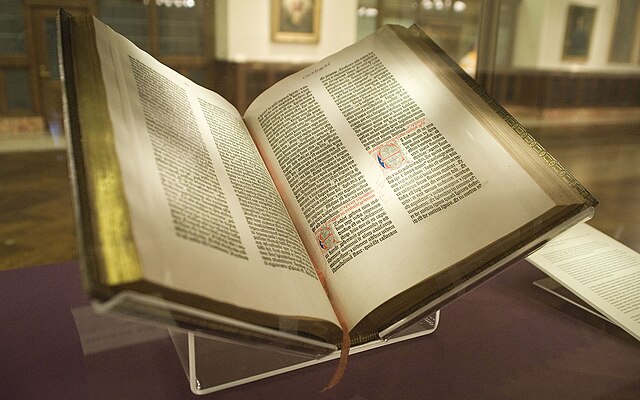
Often called the 42-line Bible because most pages contain 42 lines of text, the work was printed in Latin, using the Vulgate translation prepared by Saint Jerome. Its appearance closely resembled the finest handwritten manuscripts of the period, helping printed books gain acceptance among readers accustomed to illuminated religious texts.
Background
Before the Gutenberg Bible, books in Europe were copied by scribes, a labor-intensive process that made them expensive and relatively scarce. Gutenberg’s innovation combined several technologies: movable metal type, oil-based ink suited to printing, and a press adapted for applying even pressure. Together, these advances allowed the efficient production of many nearly identical pages.
The project was expensive and required substantial investment. Gutenberg entered into a financial arrangement with Johann Fust, a wealthy backer, to fund the printing operation. Their partnership later ended in a legal dispute, but by then the Bible had already shown the commercial and cultural potential of printing.
Production and Design
The Gutenberg Bible was printed in two volumes and is admired for both technical precision and artistic beauty. The text was set in a blackletter typeface that imitated the formal script used by scribes. Although the printed words were mechanically produced, many copies were later decorated by hand with colored initials, rubrication, and ornamental details. This blending of print and manuscript traditions helped make the book attractive to wealthy buyers.
Scholars estimate that around 180 copies were produced, including copies on paper and a smaller number on vellum. Not all survive, but dozens of copies and fragments remain today in libraries, museums, universities, and private collections. The survival of so many examples has allowed historians to study early printing methods in unusual detail.
Impact and Legacy
The Gutenberg Bible marked a turning point in the spread of knowledge. It proved that large, authoritative texts could be reproduced more quickly and accurately than before, reducing the cost of books over time and increasing access to written material. While literacy did not suddenly become universal, printing helped lay the foundation for broader education, the Renaissance, the Reformation, and the Scientific Revolution.
Its influence extends beyond religion. The success of the Gutenberg Bible encouraged the rapid growth of print shops across Europe in the late fifteenth century. Within decades, printers were producing not only Bibles but also legal texts, classical literature, scientific works, and vernacular books.
Today, the Gutenberg Bible remains a landmark of book history, printing technology, and documentary heritage. It symbolizes the beginning of the print age and the transformation of communication in Europe and beyond.
Did You Know?
- The Gutenberg Bible is often called the "42-line Bible" because most pages have 42 lines of text.
- It was printed in Latin rather than German, using the Vulgate, the standard Bible of the medieval Western Church.
- Many copies were printed on paper, but some luxury copies were produced on vellum, made from animal skin.
- Surviving copies are extremely valuable and are held by institutions such as the British Library, the Library of Congress, and Gutenberg Museum in Mainz.