> PEARL HARBOR ATTACK
The Pearl Harbor attack brought the United States into World War II after a surprise Japanese strike on Hawaii.
Overview
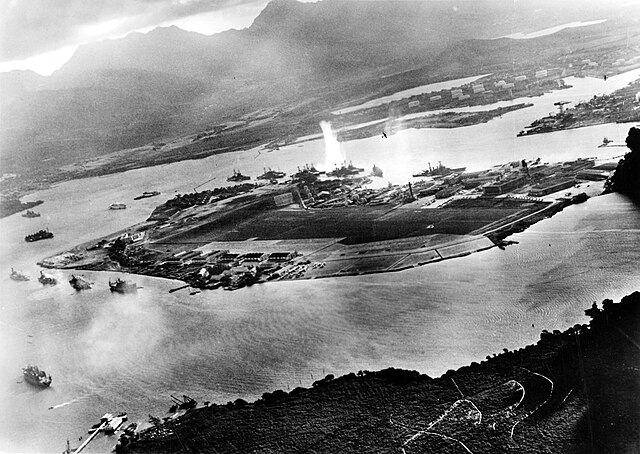
The Pearl Harbor Attack was a surprise military strike carried out by the Imperial Japanese Navy against the United States naval base at Pearl Harbor, Hawaii, on December 7, 1941. The assault targeted the U.S. Pacific Fleet and nearby military airfields in an effort to weaken American power in the Pacific. The attack lasted less than two hours but caused severe damage, sank or damaged multiple battleships, destroyed aircraft, and killed more than 2,400 Americans.
The event immediately changed the course of World War II. Before the attack, the United States had not formally entered the war, though it supported Allied nations. After Pearl Harbor, public opinion shifted rapidly, and the United States declared war on Japan on December 8, 1941. Germany and Italy then declared war on the United States, turning the conflict into a fully global war for America.
Background
Tensions between Japan and the United States had been growing for years before the attack. Japan sought to expand its empire in East Asia and the Pacific, while the United States opposed Japanese aggression in China and Southeast Asia. In response to Japan’s expansion, the U.S. imposed economic sanctions and trade restrictions, including limits on oil exports, which were crucial to Japan’s military operations.
Japanese leaders believed war with the United States might become unavoidable. They planned a sudden attack designed to cripple the U.S. Pacific Fleet long enough for Japan to secure territory across Asia and the Pacific. Admiral Isoroku Yamamoto was a central figure in developing the strategy, which relied on surprise and speed.
The Attack
On the morning of December 7, Japanese aircraft launched from six aircraft carriers north of Hawaii. They struck Pearl Harbor in two waves, using torpedo planes, bombers, and fighter aircraft. Battleships along “Battleship Row,” including the USS Arizona, USS Oklahoma, and USS West Virginia, were among the main targets. The USS Arizona exploded catastrophically after a bomb ignited its forward ammunition magazine, causing one of the highest death tolls of the day.
In addition to the naval base, Japanese forces attacked nearby airfields such as Hickam, Wheeler, and Ford Island to prevent an American air response. In total, about 188 U.S. aircraft were destroyed and many more were damaged. However, several important U.S. assets were not at Pearl Harbor, including the Pacific Fleet’s aircraft carriers, which would later play a major role in the war.
Impact and Legacy
The attack on Pearl Harbor had immediate and lasting consequences. President Franklin D. Roosevelt described December 7, 1941, as “a date which will live in infamy” in his address to Congress. The next day, Congress approved a declaration of war against Japan with only one dissenting vote.
Pearl Harbor became a symbol of both tragedy and national resolve. The attack exposed weaknesses in U.S. military preparedness and intelligence coordination, prompting major changes in defense planning. It also accelerated American mobilization for World War II, leading to a vast expansion of the military and wartime industry.
Today, the Pearl Harbor National Memorial in Hawaii honors those who died in the attack. The USS Arizona Memorial, built above the sunken battleship, remains one of the most visited historic sites connected to World War II.
Did You Know?
- The Pearl Harbor attack began at about 7:55 a.m. local time on a Sunday morning.
- More than 1,100 sailors and Marines died on the USS Arizona alone.
- Japan intended the attack to prevent U.S. interference with its expansion in Southeast Asia.
- The U.S. aircraft carriers were not in port during the attack, which proved crucial in the Pacific War.
- The attack helped unite American public opinion in favor of entering World War II.