> THE COMMUNIST MANIFESTO
Karl Marx and Friedrich Engels' 1848 pamphlet argued that class struggle drives history and called workers to revolutionary action.
Overview
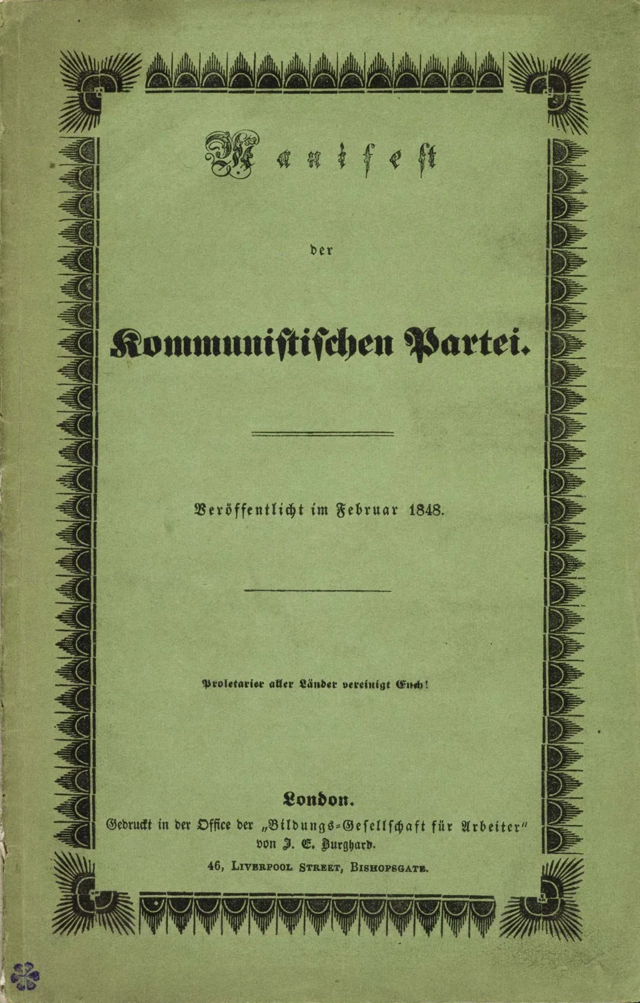
The Communist Manifesto is one of the most influential political documents in modern history. Written by Karl Marx and Friedrich Engels and published in February 1848, it was commissioned by the Communist League, a radical workers' organization based in Europe. The pamphlet set out a theory of history centered on class struggle and argued that capitalism would eventually be replaced by socialism and, later, communism.
Although relatively short, the document had an enormous long-term impact on political thought, labor movements, and revolutionary movements around the world. Its famous opening and closing lines—about the “specter of Communism” and workers of the world uniting—helped make it a defining text of modern political ideology.
Background
Marx and Engels wrote the manifesto during a period of rapid industrialization, urban growth, and social unrest. In the early nineteenth century, factories expanded across Europe, creating new wealth for industrial owners while many workers faced long hours, low pay, and unsafe conditions. These changes sharpened tensions between social classes.
The Communist League asked Marx and Engels to produce a clear statement of its principles. Their response reflected both the political turmoil of the time and their developing critique of capitalism. The manifesto appeared just as revolutions broke out across Europe in 1848, giving the text immediate historical relevance even if its first circulation was limited.
Content
The manifesto is organized into four sections. Its central claim is that “the history of all hitherto existing society is the history of class struggles.” Marx and Engels describe how social conflict shaped earlier societies and argue that modern capitalism has simplified these conflicts into a struggle between the bourgeoisie, who own the means of production, and the proletariat, who sell their labor.
The document praises capitalism for its productive power and its role in transforming society, but it also argues that capitalism is unstable and exploitative. According to Marx and Engels, competition and profit-seeking lead to crises, inequality, and the concentration of wealth. They contend that workers, increasingly organized by industrial society itself, would eventually overthrow the bourgeois order.
The manifesto also distinguishes communists from other socialist groups of the time. Marx and Engels argue that communists represent the broader interests of the working class and seek the abolition of private ownership of the means of production, not the abolition of personal possessions in general.
Impact and Legacy
At first, The Communist Manifesto had a modest reach. Its global significance grew later, especially after the rise of socialist parties in the late nineteenth century and the Russian Revolution of 1917. Over time, it became a foundational text for communist movements in Europe, Asia, Latin America, and beyond.
Its influence extends beyond governments that claimed Marxist inspiration. Historians, economists, political theorists, and critics of capitalism continue to study the manifesto for its analysis of class, industrial change, globalization, and economic crisis. At the same time, the document remains controversial because regimes that adopted Marxist-Leninist systems often developed in ways far removed from the manifesto’s original context and contributed to authoritarian rule.
Today, The Communist Manifesto is read both as a revolutionary call to action and as a major historical document of the nineteenth century. Its language, arguments, and predictions still shape debates about inequality, labor, and the future of capitalism.
Did You Know?
- The Communist Manifesto was originally published in German as Manifest der Kommunistischen Partei.
- The pamphlet was published just before the wave of European revolutions in 1848.
- Marx and Engels did not invent all socialist ideas, but their manifesto helped unify and popularize a distinct communist program.
- One of its most quoted lines is: “Workers of all countries, unite!”
- Despite its fame today, the manifesto was not an immediate mass bestseller in 1848.