> TREATY OF VERSAILLES
The Treaty of Versailles formally ended World War I between Germany and the Allies and reshaped Europe with lasting consequences.
Overview
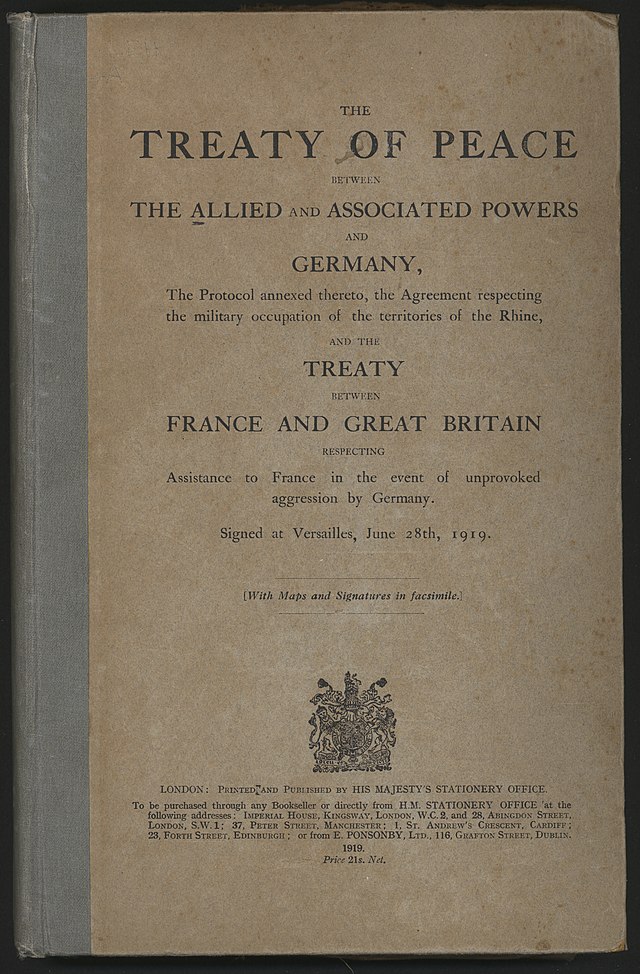
The Treaty of Versailles was the most important peace settlement produced after World War I. Signed on June 28, 1919, at the Palace of Versailles near Paris, it formally ended the state of war between Germany and the Allied Powers. Although the fighting had stopped with the armistice of November 11, 1918, the treaty set the legal terms of peace and established the framework for postwar Europe.
The agreement is best known for imposing territorial losses, military restrictions, and reparations on Germany. It also included the controversial “war guilt” clause, which assigned responsibility for the war to Germany and its allies. Historians widely view the treaty as a major factor in the political instability of the interwar period.
Background
After World War I, leaders of the victorious Allied nations met at the Paris Peace Conference in 1919 to design a new international order. The most influential figures were U.S. President Woodrow Wilson, British Prime Minister David Lloyd George, French Prime Minister Georges Clemenceau, and Italian Prime Minister Vittorio Orlando.
Their goals differed sharply. Wilson promoted his Fourteen Points, calling for self-determination, open diplomacy, and a League of Nations to preserve peace. Clemenceau wanted strong measures to weaken Germany and protect France from future invasion. Lloyd George sought a balance between punishing Germany and preserving European stability. These competing aims shaped the final treaty.
Germany was not allowed to negotiate the terms directly and was presented with the treaty largely as a finished document. This fueled resentment in Germany, where many viewed the settlement as a dictated peace.
Main Terms
The Treaty of Versailles imposed several major conditions on Germany. It required Germany to return Alsace-Lorraine to France, recognize the independence of Poland, and surrender territory to Belgium, Denmark, and the newly created Polish state. Germany also lost all of its overseas colonies, which were transferred as mandates under League of Nations supervision.
The treaty sharply limited the German military. The army was capped at 100,000 men, conscription was banned, and Germany was forbidden from maintaining tanks, military aircraft, and submarines. The Rhineland was demilitarized to create a buffer between Germany and France.
Financially, Germany was required to pay reparations for war damage. The exact total was later set at 132 billion gold marks. Article 231, often called the war guilt clause, declared that Germany and its allies were responsible for causing the war, providing the legal basis for these payments.
Impact and Legacy
The Treaty of Versailles redrew the map of Europe and helped create several new or expanded states in Central and Eastern Europe. It also established the League of Nations, an early international organization intended to prevent future wars.
However, the treaty had serious weaknesses. Many Germans saw it as humiliating and unjust, which undermined support for the new Weimar Republic. Economic strain, nationalist anger, and political extremism were intensified by the settlement, even though historians debate how directly reparations caused Germany’s later crises.
In the long term, the treaty failed to secure lasting peace. Its harsh terms, combined with weak enforcement and changing international politics, contributed to tensions that helped lead to World War II. Today, the Treaty of Versailles remains a central subject in the history of diplomacy, peace settlements, and the aftermath of war.
Did You Know?
- The treaty was signed exactly five years after the assassination of Archduke Franz Ferdinand on June 28, 1914.
- Although U.S. President Woodrow Wilson helped shape the peace talks, the United States Senate never ratified the Treaty of Versailles.
- The Hall of Mirrors at the Palace of Versailles was chosen as the signing site, a symbolic location because the German Empire had been proclaimed there in 1871.
- Germany’s army was limited to 100,000 soldiers, with no tanks or air force allowed under the treaty.