> UNITED STATES BILL OF RIGHTS
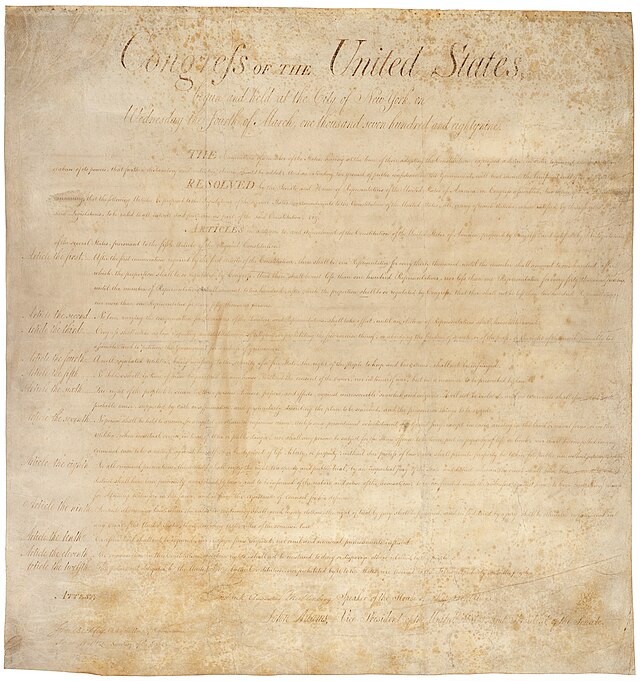
The United States Bill of Rights is the first ten amendments to the Constitution, protecting key civil liberties and limiting federal power.
Overview
The United States Bill of Rights is the collective name for the first ten amendments to the U.S. Constitution. Ratified on December 15, 1791, these amendments were designed to protect individual freedoms, limit the power of the federal government, and reassure citizens who feared centralized authority. Today, the Bill of Rights remains one of the most important legal and political documents in American history.
The amendments safeguard core rights such as freedom of speech, religion, press, assembly, and petition. They also address criminal justice, property rights, and the relationship between citizens, states, and the federal government. Together, they form a foundation for American civil liberties.
Background
When the Constitution was drafted in 1787, it created a stronger national government than the one established under the Articles of Confederation. While many supported the new framework, critics known as Anti-Federalists worried that the Constitution did not do enough to protect individual rights.
Several state ratifying conventions called for amendments that would clearly define and secure personal liberties. In response, James Madison introduced a series of proposed amendments in the First Congress in 1789. Drawing on state declarations of rights, English legal traditions, and Enlightenment political thought, Madison helped shape what became the Bill of Rights.
Ten of the proposed amendments were approved by the states and officially ratified in 1791.
Content
The Bill of Rights addresses a wide range of legal and political protections. The First Amendment guarantees freedoms of religion, speech, press, peaceful assembly, and petition. The Second Amendment concerns the right to keep and bear arms. The Third Amendment restricts the quartering of soldiers in private homes without consent.
The Fourth through Eighth Amendments focus heavily on justice and due process. They protect against unreasonable searches and seizures, require fair legal procedures, guard against self-incrimination and double jeopardy, guarantee a speedy and public trial, and prohibit excessive bail, excessive fines, and cruel and unusual punishment.
The Ninth and Tenth Amendments are especially important for constitutional interpretation. The Ninth states that people retain rights beyond those specifically listed in the Constitution. The Tenth reserves powers not delegated to the federal government to the states or the people.
Impact and Legacy
The Bill of Rights did not initially apply to state governments in the same way it applied to the federal government. Over time, however, many of its protections were extended to the states through the Fourteenth Amendment and a process known as incorporation.
Its influence on American law has been profound. Major Supreme Court decisions have interpreted the Bill of Rights in areas such as free speech, gun rights, religious liberty, criminal procedure, and privacy. It has also inspired constitutional movements around the world by providing a model for codified civil liberties.
In public life, the Bill of Rights remains central to debates over government authority and personal freedom. Its language is frequently cited in courtrooms, classrooms, elections, and civic activism, showing its continuing relevance more than two centuries after ratification.
Did You Know?
- The Bill of Rights was ratified on December 15, 1791, a date now observed as Bill of Rights Day in the United States.
- James Madison is often called the “Father of the Bill of Rights” because he drafted and promoted the amendments in Congress.
- Congress originally sent 12 proposed amendments to the states, but only 10 were ratified in 1791.
- One of the two unratified amendments from 1789 eventually became the 27th Amendment in 1992.
- The Third Amendment is one of the least litigated parts of the Constitution, largely because quartering soldiers in private homes is rare.