> UNIVERSAL DECLARATION OF HUMAN RIGHTS
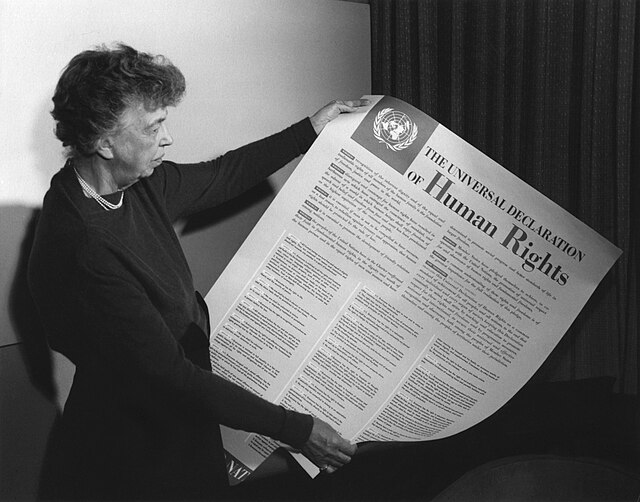
Adopted by the United Nations in 1948, the Universal Declaration of Human Rights set a global standard for basic rights and freedoms.
Overview
The Universal Declaration of Human Rights (UDHR) is one of the most important documents in modern history. Adopted by the United Nations General Assembly on 10 December 1948 in Paris, it set out a common standard of fundamental rights and freedoms for all people. Although it is not a legally binding treaty, the declaration became the foundation for international human rights law and has influenced constitutions, courts, and treaties around the world.
The UDHR was created in response to the destruction and atrocities of the Second World War, including the Holocaust. Its purpose was to affirm that every human being possesses inherent dignity and equal rights, regardless of nationality, race, sex, religion, or social status.
Background
The idea for the declaration emerged as the United Nations was formed in 1945. The UN Charter pledged support for human rights, but it did not define them in detail. To address this, the UN established a Commission on Human Rights to draft a document that could guide nations and set an international moral standard.
A key figure in the drafting process was Eleanor Roosevelt, who chaired the commission and helped build international agreement. Other major contributors included René Cassin of France, Charles Malik of Lebanon, Peng-chun Chang of China, and John Humphrey of Canada. Their work reflected a broad effort to create a document with universal principles, despite political, religious, and cultural differences among member states.
Content
The Universal Declaration of Human Rights contains a preamble and 30 articles. It begins with the principle that all human beings are born free and equal in dignity and rights. The declaration includes civil and political rights, such as the right to life, liberty, fair trial, freedom of expression, and freedom of religion. It also recognizes economic, social, and cultural rights, including the rights to work, education, rest, and an adequate standard of living.
The document rejects slavery, torture, arbitrary arrest, and discrimination. It also emphasizes that rights come with responsibilities to the community and that no state, group, or person should destroy the rights listed in the declaration.
Its broad language was intentional. The drafters wanted a text that could apply across nations and legal systems while still clearly stating universal human rights principles.
Impact and Legacy
The UDHR had a lasting global impact. It inspired later binding agreements, including the International Covenant on Civil and Political Rights and the International Covenant on Economic, Social and Cultural Rights. Together with the UDHR, these texts form the core of the International Bill of Human Rights.
The declaration also shaped anti-colonial movements, civil rights campaigns, women’s rights advocacy, and efforts to protect refugees and minorities. Courts and lawmakers continue to cite it as a source of authority and guidance. While many governments have violated its principles, the UDHR remains a powerful benchmark for justice and accountability.
Its influence extends beyond law. Every year, Human Rights Day is observed on 10 December, marking the anniversary of its adoption and reinforcing its continuing relevance in global debates over freedom, equality, and human dignity.
Did You Know?
- The Universal Declaration of Human Rights was adopted by a vote of 48 in favor, none against, and 8 abstentions.
- It has been translated into hundreds of languages, making it one of the most translated documents in the world.
- Eleanor Roosevelt called it the international “Magna Carta for all mankind.”
- The UDHR was adopted at the Palais de Chaillot in Paris.
- Although not a treaty itself, it influenced many national constitutions and international human rights conventions.