> US CONSTITUTION
The US Constitution established the framework of the federal government and remains the supreme law of the United States.
Overview
The US Constitution is the foundational legal document of the United States. Drafted in 1787 and put into effect in 1789, it created a stronger national government to replace the weaker system established under the Articles of Confederation. The Constitution defines the structure of the federal government, outlines the powers of its branches, and limits government authority through checks and balances.
It remains the supreme law of the land, meaning that federal and state laws must conform to it. Since its adoption, the Constitution has guided American political life and served as a model for constitutional systems around the world.
Background
After independence, the United States operated under the Articles of Confederation, which gave most power to the states and left the national government too weak to address major problems. Congress could not reliably raise revenue, regulate interstate commerce, or enforce national decisions. Economic instability and internal unrest, including Shays’ Rebellion in 1786–1787, convinced many leaders that reform was necessary.
In May 1787, delegates from twelve states met in Philadelphia for what became the Constitutional Convention. Rather than merely revising the Articles, they drafted an entirely new framework of government. Key figures included George Washington, who presided over the convention, James Madison, often called the “Father of the Constitution,” and Benjamin Franklin. The debates reflected major disagreements over representation, federal power, and slavery.
Content and Structure
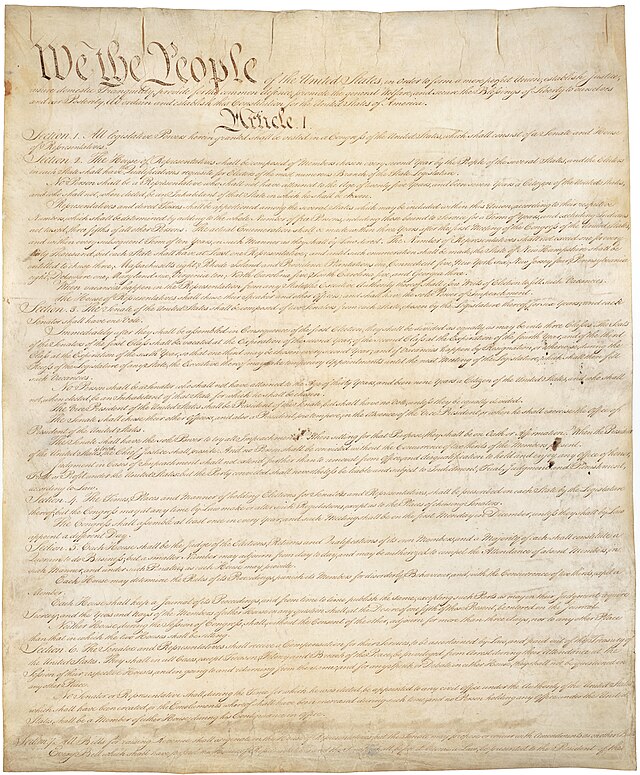
The Constitution begins with the famous Preamble: “We the People,” emphasizing that government derives its authority from the citizens. The main body is organized into seven articles.
Article I establishes the legislative branch, or Congress, made up of the House of Representatives and the Senate. Article II creates the executive branch led by the president. Article III establishes the judicial branch, including the Supreme Court. Together, these three branches form a system designed to prevent any one part of government from becoming too powerful.
Other articles address relations among the states, the amendment process, federal supremacy, and ratification. The Constitution also reflects political compromises reached during the convention, such as the Great Compromise, which balanced large and small states by creating two houses of Congress with different forms of representation.
Although the original Constitution was powerful, many Americans demanded explicit protections for individual rights. In response, the first ten amendments, known as the Bill of Rights, were added in 1791. These amendments protect freedoms such as speech, religion, press, assembly, and due process.
Ratification and Legacy
The Constitution did not take effect immediately. It had to be ratified by specially elected conventions in nine states. This sparked a major public debate between Federalists, who supported the Constitution, and Anti-Federalists, who feared centralized power and the lack of a bill of rights. The Federalist Papers, written by Alexander Hamilton, James Madison, and John Jay, argued in favor of ratification.
Once adopted, the Constitution provided the framework for a durable federal republic. Over time, amendments and Supreme Court interpretations have expanded and clarified its meaning. Major changes include the abolition of slavery, equal protection under the law, expanded voting rights, and revised procedures for electing senators and presidents.
The US Constitution remains a living part of American government. Its endurance rests on both its flexibility and its core principles: limited government, separation of powers, federalism, and popular sovereignty.
Did You Know?
- The Constitution was signed on September 17, 1787, in Philadelphia.
- Rhode Island was the last of the original thirteen states to ratify the Constitution, doing so in 1790.
- James Madison took detailed notes at the Constitutional Convention, which later became a key historical source.
- The Bill of Rights was added partly to win support from critics during the ratification debate.
- The original Constitution has been amended 27 times.