> WORLD WAR I
A global war from 1914 to 1918 reshaped empires, warfare, and international politics.
Overview
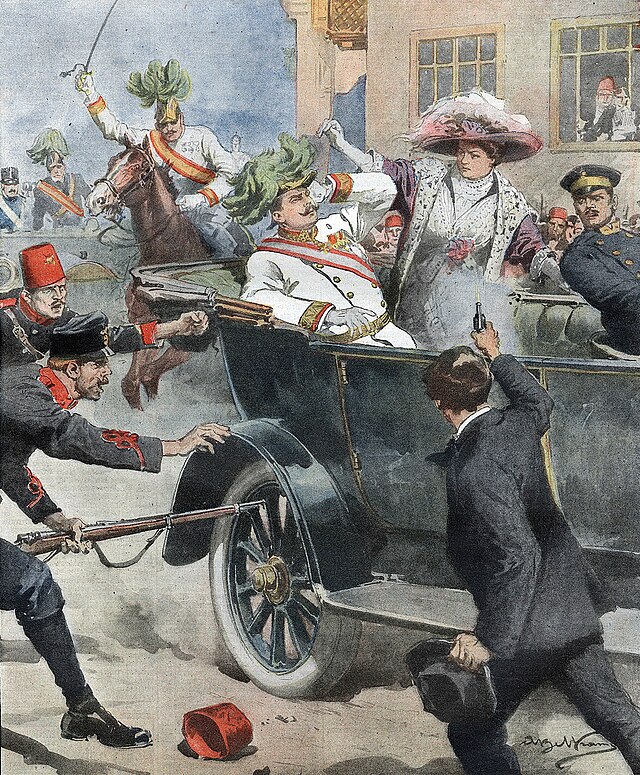
World War I was a global conflict fought primarily in Europe from 1914 to 1918. It began after the assassination of Archduke Franz Ferdinand of Austria-Hungary in Sarajevo on June 28, 1914, but its deeper causes included nationalism, imperial rivalry, militarism, and a complex system of alliances. The two main sides were the Allied Powers, including Britain, France, and Russia, later joined by Italy and the United States, and the Central Powers, led by Germany, Austria-Hungary, the Ottoman Empire, and Bulgaria.
The war became one of the deadliest conflicts in history up to that time. It involved mass mobilization, industrial-scale killing, and new military technologies that transformed modern warfare. By the end, millions of soldiers and civilians had died, and several major empires had collapsed.
Background
Europe in the early 20th century was marked by intense competition among great powers. Germany had grown into a major industrial and military force, challenging Britain and France. Austria-Hungary and the Ottoman Empire were weakening, while nationalist movements in the Balkans created instability. At the same time, alliances such as the Triple Entente and the Triple Alliance meant that a regional crisis could quickly become a continental war.
The assassination of Franz Ferdinand by Gavrilo Princip, a Bosnian Serb nationalist, triggered a diplomatic crisis known as the July Crisis. Austria-Hungary, backed by Germany, declared war on Serbia. Russia mobilized in support of Serbia, Germany declared war on Russia and France, and Britain entered the war after Germany invaded neutral Belgium.
Key Moments
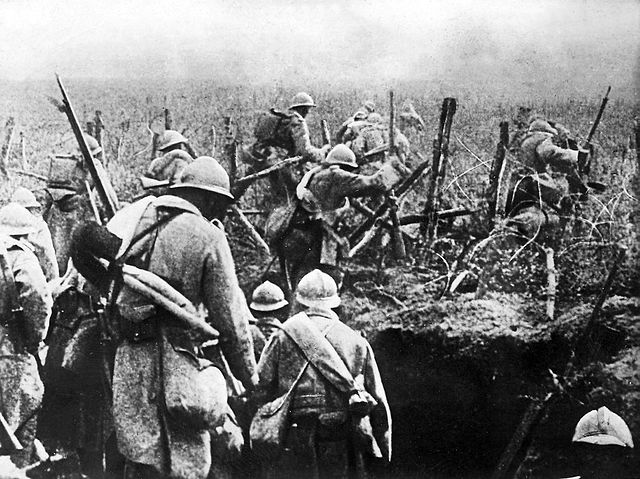
Much of the fighting on the Western Front turned into trench warfare, especially after the First Battle of the Marne in 1914 halted Germany’s advance toward Paris. Soldiers endured mud, artillery bombardment, disease, and repeated assaults that often gained little ground at enormous human cost. Battles such as Verdun and the Somme in 1916 became symbols of attrition and sacrifice.
The war was not limited to the Western Front. Major campaigns took place on the Eastern Front, in the Middle East, Africa, and at sea. The Ottoman Empire entered the conflict in late 1914, leading to fighting at Gallipoli and across Arab territories. Germany’s use of unrestricted submarine warfare threatened Allied shipping and contributed to the United States entering the war in 1917.
That same year, the Russian Revolution led to Russia’s withdrawal from the war. In 1918, Germany launched a major spring offensive before fresh American troops helped strengthen the Allied side. The Allies then pushed back in a series of successful offensives, and the fighting ended with the Armistice of November 11, 1918.
Impact and Legacy
World War I reshaped the political map of Europe and the Middle East. The German, Austro-Hungarian, Russian, and Ottoman Empires all fell. New nations emerged, and the Treaty of Versailles imposed heavy penalties on Germany. Many historians view the treaty’s harsh terms and unresolved tensions as important factors leading to World War II.
The war also changed society. It accelerated advances in medicine, communications, and military technology, including tanks, aircraft, machine guns, poison gas, and submarines. It altered gender roles as women took on wider economic responsibilities during wartime. The conflict left deep cultural scars and inspired literature, memorials, and remembrance traditions that continue today.
Did You Know?
- The war was originally called the “Great War” before the term “World War I” became common after World War II.
- More than 70 million military personnel were mobilized during the conflict.
- The 1914 Christmas Truce saw some British and German soldiers briefly stop fighting and meet in no man’s land.
- The armistice took effect on the 11th hour of the 11th day of the 11th month in 1918.
- World War I helped bring about the collapse of four major empires: German, Russian, Austro-Hungarian, and Ottoman.