> WORLD WAR II
A global conflict fought from 1939 to 1945 that reshaped borders, politics, technology, and international relations.
Overview
World War II was a global war fought between 1939 and 1945, involving most of the world’s nations. It began in Europe when Nazi Germany invaded Poland on September 1, 1939, prompting Britain and France to declare war. The conflict soon expanded across Europe, North Africa, Asia, and the Pacific, becoming the deadliest war in human history.
The two main sides were the Axis powers—primarily Germany, Italy, and Japan—and the Allies, led by Britain, the Soviet Union, the United States, China, and many other countries. The war was marked by large-scale military campaigns, strategic bombing, genocide, resistance movements, and major advances in weapons and communications.
Background
The roots of World War II lay partly in the unsettled aftermath of World War I. The Treaty of Versailles imposed harsh penalties on Germany, fueling resentment and political instability. During the 1930s, economic crisis and the Great Depression helped extremist movements gain support. Adolf Hitler and the Nazi Party rose to power in Germany, promoting militarism, expansionism, and racist ideology.
At the same time, Imperial Japan pursued aggressive expansion in East Asia, invading China in 1937. Fascist Italy under Benito Mussolini also sought territorial gains. The failure of the League of Nations and the policy of appeasement by some European powers allowed aggressive states to expand with limited resistance before full-scale war began.
Key Moments
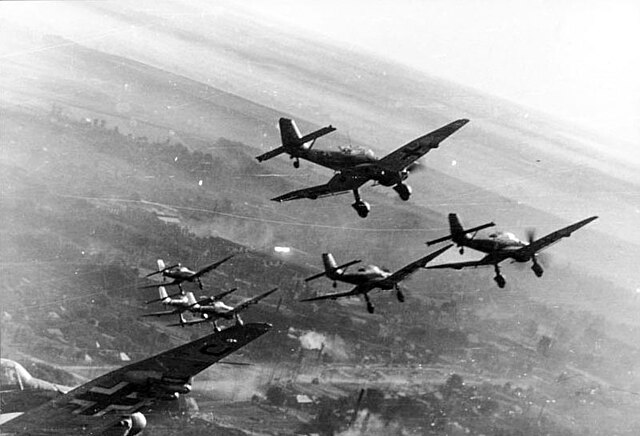
Germany’s early victories relied on blitzkrieg, or “lightning war,” a fast-moving combination of tanks, aircraft, and infantry. Poland fell quickly, followed by Denmark, Norway, the Netherlands, Belgium, and France in 1940. Britain resisted during the Battle of Britain, preventing a German invasion.
In 1941, Hitler launched Operation Barbarossa, the invasion of the Soviet Union, opening the war’s largest land front. That same year, Japan attacked Pearl Harbor on December 7, bringing the United States into the war. The conflict then became fully global.
Several turning points shifted momentum toward the Allies. The Soviet victory at Stalingrad in 1943 weakened Germany’s eastern campaign. In North Africa and Italy, Allied offensives pushed Axis forces back. On June 6, 1944, D-Day began the Allied invasion of Nazi-occupied France. In the Pacific, battles such as Midway and Guadalcanal checked Japanese expansion.
Germany surrendered in May 1945 after Allied forces advanced from west and east. The war ended in Asia after the United States dropped atomic bombs on Hiroshima and Nagasaki in August 1945, and the Soviet Union declared war on Japan. Japan surrendered on September 2, 1945.
Impact and Legacy
World War II caused immense destruction and loss of life, with an estimated 70 to 85 million deaths, including soldiers and civilians. The Holocaust, in which Nazi Germany systematically murdered six million Jews and millions of other victims, remains one of history’s greatest crimes.
The war transformed global power. The United States and the Soviet Union emerged as superpowers, leading to the Cold War. The United Nations was founded in 1945 to promote peace and international cooperation. Decolonization accelerated in Asia and Africa, while Europe began a long process of reconstruction.
The war also changed science, industry, and society. Radar, rocketry, computing, and nuclear technology advanced rapidly. At the same time, the war left lasting moral and political lessons about aggression, genocide, and the importance of international alliances.
Did You Know?
- World War II involved more than 30 countries and was fought on multiple continents and oceans.
- The Battle of Stalingrad is widely considered one of the war’s most decisive turning points.
- The Holocaust was carried out through ghettos, mass shootings, concentration camps, and extermination camps.
- The United Nations was created in 1945 in direct response to the devastation of two world wars.
- V-E Day marks Germany’s surrender in Europe, while V-J Day marks Japan’s surrender and the end of the war.